
This article is general education, not personalized financial advice. Every financial situation is different. If you are experiencing serious financial distress, please consider speaking with a nonprofit credit counselor or financial professional.
Maybe you have been meaning to “get your finances together” for months now. Maybe years. You know you should be doing something, but every time you try to start, the options feel endless and you end up closing the tab and doing nothing.
That feeling is not laziness. It is what happens when a task feels too big and too undefined to begin. And it is more common than you think.
Here is the good news: there is one move that cuts through all of it. Not a budget. Not an investment account. Not a five-step plan. Just one thing that will give you more clarity about your money in the next hour than you have had in years.
Find out what is coming in and what is going out.
That is it. That is the whole first step.
The one move: Before any budget, account, or plan, find out what comes in and what goes out each month. One hour of honest looking gives you more clarity than years of worrying.
Why This One Thing Works
Most money advice skips straight to the solution. Open a savings account. Start investing. Build an emergency fund. Those things matter eventually, but they all assume you already know where you stand. You cannot navigate somewhere new without first knowing where you are.
Think about it this way. If you decided to get healthier and someone immediately told you to eat fewer than 1,800 calories a day, that advice is useless until you know how many calories you are actually eating right now. Most people are genuinely surprised by that number, in both directions. Money works the same way. You cannot make smart decisions about where your money should go until you see clearly where it is already going.
My wife sat down to do this exercise for the first time and discovered she was spending over $200 a month on water bottles she picked up at work. Not a conscious decision she had made. Just a small daily habit that had never been added up before. She had no idea. Once she saw it, she could decide what to do about it. Before she saw it, that choice did not even exist for her.
That is what this exercise gives you: choices. And choices are the beginning of control.
What You Are Actually Looking For
You are looking for two numbers.
The first is what comes in each month. This is your income after taxes, meaning the actual amount that lands in your bank account. If your income changes month to month, that is fine. Write down a few recent months and you will see a range.
The second is what goes out each month. This includes everything: rent or mortgage, groceries, subscriptions, gas, eating out, online shopping, coffee, the gym membership you forgot about. Everything.
You are not judging any of it yet. You are just looking. The only job right now is to see the full picture.
Here is what one month can look like once you lay it out. These numbers are made up. Yours will be different, and that is the whole point: the value is in seeing your own.
| One example month | Amount |
|---|---|
| Money coming in (after tax) | $3,200 |
| Housing | $1,150 |
| Food | $520 |
| Transportation | $260 |
| Subscriptions | $85 |
| Everything else | $640 |
| Total going out | $2,655 |
| What is left | $545 |
How to Do It, Step by Step
Step 1: Choose your tool.
Use whatever feels easiest. There is no right answer here. See the resources section at the bottom of this article for a few options, from free apps to a simple notebook. The tool you will actually use is the right tool.
Step 2: Start with one month.
Pull up your bank transactions from last month. Go line by line. Write down or note every expense you see. Do not try to fix anything or make decisions yet. Just record what happened.
One month gives you a starting picture. It will not be perfect because life is not perfectly consistent month to month, but it is enough to begin.
Step 3: Group your spending into simple categories.
You do not need a complicated system. A few broad buckets are enough to start: housing, food, transportation, subscriptions, everything else. The goal is to see where the money actually went, not to create an accounting system.
Step 4: Add it up.
Total your income for the month. Total your spending for the month. Write both numbers down. Then subtract spending from income.
That number, positive or negative, is your starting point. Not a grade. Not a verdict. Just information.
Step 5: Notice what surprises you.
Almost everyone finds at least one thing they did not expect. A subscription they forgot. A category that ran higher than they imagined. A forgotten recurring charge. Do not react to it yet. Just note it.
You might also start to notice a natural split forming: some things you spent money on because you had to, and some things you chose. That distinction is worth sitting with. It is not a judgment. It is just the beginning of a useful question we can explore together later.
One Month Is a Start. A Full Year Is a Map.
Once you have done one month, you will probably want to go further, and that instinct is a good one.
A single month can miss things. Quarterly subscriptions only appear every three months. Holiday gift spending only shows up in November and December. A summer vacation is a once-a-year event. If you only look at January, you might think you spend nothing on gifts or travel, when in reality those costs are real and they are coming.
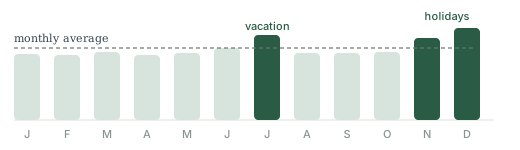
Looking at a full year of spending shows you the seasonality of your own financial life. It turns a snapshot into a map. That is when the picture becomes genuinely useful for planning.
You do not have to do this all at once. Start with one month. Come back later for the rest.
A Note on How This Feels
This exercise can bring up complicated feelings. Anxiety. Regret. Even a little shame.
If that happens, it is worth knowing that almost everyone who does this for the first time feels some version of that. It is not a sign that you are bad with money or that things are hopeless. It is the normal response to finally seeing something you have been avoiding.
I have been there myself. At one point I was carrying more than $200,000 in debt across credit cards and loans. I know what it feels like to lie awake at night running numbers in your head. What I also know is that the moment I sat down and actually looked at everything clearly, the anxiety started to shift. Not because the numbers were good, they were not. But seeing the truth gave me something to work with and a path forward I could see, even if it was going to be a long journey. The uncertainty was worse than the reality.
You are not behind. You are starting. Those are not the same thing.
Your One Next Step
Open your bank app right now and look at last month’s transactions. Just look. You do not need to write anything down yet or make any decisions. Just see what is there.
That is the whole step.
Quick Recap
- The first money move is simply finding out what comes in and what goes out each month.
- Start with one month. Add up income, add up spending, note what surprises you.
- One month is a start. A full year shows the full picture, including seasonal expenses you would otherwise miss.
Common Questions
Where do I start if I have never tracked my money before?
Open your bank app and read last month’s transactions, line by line. You are not budgeting yet. You are only seeing what is there. That single hour is the whole first step.
What if I have debt and no savings?
Start the same way. Seeing the full picture matters more when money is tight, not less. Once you know what comes in and what goes out, you can decide your next move from facts instead of fear.
Do I need an app, or is a notebook fine?
Either works. The tool you will actually use is the right tool. Free apps connect to your bank and sort transactions for you. A notebook or a free spreadsheet works just as well if you would rather go slow.
How long does this take?
About an hour for one month of transactions. You do not have to do a full year right away. Start with one month and come back for the rest later.
Resources
These tools can help you track your income and spending. None of these are endorsements, and this site has no financial relationship with any of them. They are starting points.
- NerdWallet (free, no paywall, connects to your bank, tracks spending and cash flow)
- Empower (free, connects most accounts, good for seeing your full financial picture in one place)
- YNAB (You Need a Budget) (paid, stronger for active budgeting once you have your baseline)
- Google Sheets Household Budget Template (free, no download needed, works in any browser with a free Google account)
John Cho is the founder of BeginnerFinanceHub.com, a resource for people who are new to personal finance and want a calm, clear place to start. Learn more about John