
This article is general education, not personalized financial advice. Every financial situation is different. Investing involves risk, including the possible loss of principal. Nothing here should be taken as a recommendation to buy or sell any specific investment.
There was a long stretch of my early 20s where the idea of investing anything terrified me. Every time the stock market came up in conversation, my mind went straight to crashes. The word “invest” made me picture people losing everything overnight. It felt like gambling, and gambling felt like something you did when you had money you could afford to throw away.
I did not have that kind of money.
What I did not understand then, and what I wish someone had explained to me plainly, is that investing does not have to be complicated or dangerous. The version of it that actually works for most beginners is, honestly, kind of boring. And that is exactly why it works.
The boring strategy wins: Time in the market, a simple mix of index funds, and the discipline to leave it alone will almost always outperform trying to be clever. I learned this the hard way, more than once.
Why the Stock Market Feels Like Gambling (and Why That Makes Sense)
If you grew up watching the news during the 2008 financial crisis, or the steep drops of 2020, or any of the dozens of times headlines screamed about the market collapsing, it makes complete sense that investing feels dangerous. That is almost all most of us ever heard about the market. We heard about crashes. We rarely heard about the recoveries. We got the dramatic part, not the full picture.
Morgan Housel writes in The Psychology of Money (2020): “Your personal experiences with money make up maybe 0.00000001% of what’s happened in the world, but maybe 80% of how you think the world works.” That landed for me because it described exactly what had happened. My experience of the market, for years, was crash headlines. So that is what I believed the market was.
What actually changed my thinking was understanding the difference between investing in the broad market over time and gambling. Gambling is zero-sum: someone wins and someone loses, and the house takes a cut no matter what. Investing in a diversified basket of stocks means owning small pieces of real companies. When those companies grow and generate profits over time, so does your stake. The outcome is not guaranteed in any single year. But the direction of the broad market, over long time horizons and accounting for every crash along the way, has historically been upward.
Short-term drops are real and they can be sharp. They happen regularly, and they look genuinely frightening while they are happening. The important context is that every major market decline in modern history has eventually recovered. The question is not whether the market will go down again. It will. The question is whether you will still be there when it comes back.
This is not a promise that things will always work out. It is a description of what has happened historically. Past performance does not guarantee future results, and any serious conversation about investing has to include that caveat. But it is also context that matters when the fear reflex kicks in.

What Investing Actually Means, in the Simplest Terms
Investing is putting money into something with the expectation that it will grow in value over time. That is it.
The simplest version for a beginner is an index fund: a fund designed to track a broad market index, like the S&P 500. When you buy a share of an S&P 500 index fund, you are buying a proportional slice of 500 of the largest companies in the United States at once. You are not picking one company. You are not betting on one industry. You are owning a piece of a lot of things simultaneously.
If those companies as a group grow over time, your investment grows with them. If the market drops, your investment drops too, temporarily. The bet you are making is not that any single company will win. It is that the broad American economy will be worth more in 20 years than it is today. That is a much less specific and much more historically supported bet than trying to pick a winner.
The reason this works over time comes down to compounding. Returns earned on top of previous returns cause growth to accelerate. A rough rule of thumb called the Rule of 72 says that money doubles in roughly 72 divided by your annual return in years. At the S&P 500’s long-run historical average of around 10% per year nominal, that is roughly 7 years to double. That is a past average, not a guarantee, and any individual year can be wildly different. But it gives you a feel for what patience does for you if you start early.
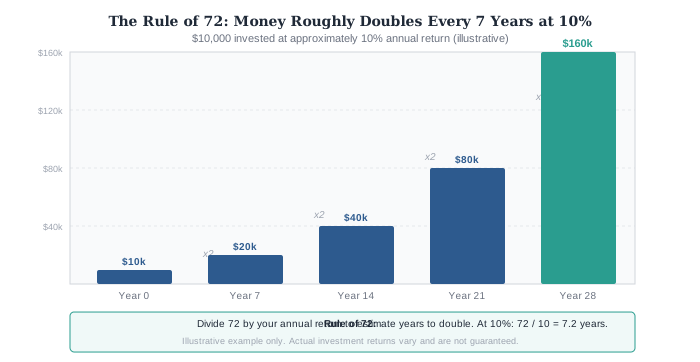
This is why the timing of when you start matters more than most people realize. Not because the market always goes up in the short term, but because you need years, ideally decades, for compounding to do its work. Money invested at 25 has far more time than money invested at 45. I started my 401(k) two years into my career, and I still wish I had started from day one.
How I Actually Think About Where to Begin
I am not going to tell you what to invest in. That is genuinely a personal decision that depends on your situation, your goals, and your risk tolerance. What I can share is how I think about the order of operations, because having a framework would have helped me enormously when I was starting out.
Start with any employer match
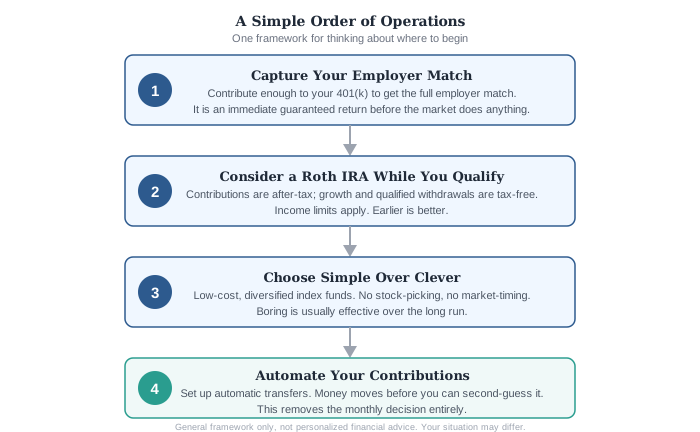
If your employer offers a 401(k) with a matching contribution and you are not contributing enough to capture the full match, that tends to be the first thing worth addressing. A match is money your employer adds to your retirement account when you contribute. Not capturing it is leaving guaranteed money on the table.
The math is striking: if your employer matches 50 cents on every dollar you contribute up to 6% of your salary, and you contribute 6%, you have already earned a 50% return on that portion before the market does anything. That is not a metaphor. That is just arithmetic. No investment strategy I have found reliably beats a guaranteed 50% return the day the money lands.
I kept contributing to my 401(k) even during the years I was paying off significant debt. It felt painful to watch money leave my paycheck when I owed so much. But I never dropped below the contribution level needed to capture my full employer match. I could not walk away from that math.
Consider a Roth IRA while you qualify
A Roth IRA is an individual retirement account where you contribute money you have already paid taxes on. The money grows tax-free, and when you withdraw it in retirement you pay no tax on the earnings. It is one of the most beginner-friendly retirement accounts available, and the earlier you open one, the better.
The reason I mention it specifically for beginners: the ability to contribute to a Roth IRA phases out at higher income levels. If you are early in your career and your income is lower, now may be one of your best windows to use it. I did not learn the Roth IRA existed until my income had already grown past the eligibility threshold. I permanently lost those lower-income years where I could have been building a tax-free account. That still stings.
The IRS sets both contribution limits and income thresholds each year. You can find the current figures at IRS.gov. Whether a Roth or a Traditional IRA is the better fit for your specific situation is worth discussing with a fee-only financial counselor or advisor who does not earn a commission on what you choose.
Choose simple over clever
When I first started investing money outside my retirement accounts, I tried picking individual stocks. In 2019, everything I picked was up 40% or more, and I genuinely believed I had figured something out. What I did not realize until later was that 2019 was an exceptional year for the whole market, up over 30%. Anyone who had simply bought a broad index fund would have come close to the same result, without any of the research or concentrated risk. I was not smart. I was riding a wave.
A few years later, I built what I convinced myself was a sophisticated system to detect market signals and tell me when a crash was coming. I went all to cash, waiting. The market went up about 10%. I eventually gave up and went back to my regular index fund mix. My own index funds had outperformed my elaborate strategy.
None of this is unusual. The research on active investing is difficult to argue with: in a 2020 study tracking all equity-futures day traders in Brazil over several years (Chague, De-Losso, and Giovannetti, “Day Trading for a Living?”), roughly 97% lost money and under 1% were reliably profitable. Separate research on market timing finds that missing just the 10 best trading days in the market over a multi-decade period can roughly cut your long-run returns in half.
The simplest long-term approach for most beginners is a diversified mix of low-cost index funds and the discipline not to tinker with it constantly. Not flashy. Not exciting. Effective.
Automate so you do not have to decide every month
One of the better decisions I made early on was setting my contributions to happen automatically. (If you are still working out your monthly numbers first, How to Budget for Beginners (Without Hating It) covers that step.) Every paycheck, a set amount moves into my retirement accounts and investment accounts without me making a fresh decision about it. This approach is called dollar-cost averaging: you invest a fixed amount at regular intervals regardless of what the market is doing. When prices are lower, your fixed dollar amount buys more shares. When prices are higher, it buys fewer. Over time, this smooths out the impact of market swings.
More importantly, it removes the monthly “is this a good time?” question. Once automated, the question disappears. The money moves before you can second-guess it.
A Few Things I Got Wrong (So You Can Skip Them)
Selling Shopify too early. Going all-cash when I thought I could see a crash coming. Picking individual stocks in a bull market and believing I was skilled rather than lucky. I have made most of the common investing mistakes.
The one that cost me the most is the Roth IRA gap. Not because I made a wrong choice, but because I did not know the account existed until the window had already closed. The information was available. Nobody pointed me to it. This site exists partly because I do not want you to find out about the Roth IRA after it is too late for you to use it.
The other lesson took me two separate painful experiences to fully absorb: the boring strategy almost always wins. The more sophisticated and interesting the approach, the more ways it has to go wrong. I am not an exception to this. Very few people are.
A line often (probably wrongly) attributed to Mark Twain captures what I have watched happen again and again: “History doesn’t repeat itself, but it often rhymes.” Market cycles have different causes and different characters, but human behavior (greed, fear, overconfidence) runs on the same patterns. The investors who do best are the ones who set up a simple system and then refuse to let the rhyming patterns spook them into action.
A Note on How This Feels
Being scared to invest is not a character flaw. It is a reasonable response to a topic that was never explained clearly, surrounded by a lot of loud, conflicting noise about what you are supposed to do with your money.
I grew up in a household where money was tight. The idea of taking savings and putting them into something that could go down felt reckless, like the opposite of responsible. For years I left money sitting in a checking account going nowhere, partly because doing something with it felt more dangerous than doing nothing.
What helped me was understanding that doing nothing is also a choice, and it has a real cost. Money sitting in a low-interest account loses purchasing power to inflation over time. The fear of investing keeps a lot of people on the sidelines while inflation quietly chips away at the value of what they have saved.
Starting small and starting imperfectly is still starting. I did not have my investment strategy fully figured out when I began. I still do not have it fully figured out. The difference is that the money has been growing the whole time I have been learning.
Your One Next Step
If you have an employer retirement account with a match and you are not currently capturing the full match, log in today and check your contribution rate. If you have no employer plan, look up the current Roth IRA contribution limits at IRS.gov and research opening one. Either of those is the right first move. Nothing more is required today.
Quick Recap
- The stock market is not gambling. It is ownership in real companies, and over long time horizons the broad market has historically grown despite every crash along the way.
- The approach that has worked for me and for most patient investors is simple: diversified index funds, consistent automated contributions, and not tinkering with it.
- The biggest mistake is waiting until you feel fully ready. Starting small and imperfectly puts time to work for you. Time is the one advantage that cannot be bought back later.
Common Questions
Do I need a lot of money to start investing?
No. Many brokerages allow you to open an account and begin investing with very small amounts, sometimes as little as one dollar. The amount matters less than the habit. A small amount invested consistently over time, with compounding doing its work, is more valuable than a large amount invested years from now.
What is the difference between a Roth IRA and a 401(k)?
A 401(k) is an employer-sponsored retirement account. Contributions are pre-tax, which reduces your taxable income now, and you pay tax on withdrawals in retirement. A Roth IRA is an individual account you open yourself. Contributions are after-tax, but growth and qualified withdrawals in retirement are tax-free. Both have annual contribution limits set by the IRS. The current limits and eligibility rules are on IRS.gov.
Is it too late to start investing if I am already in my 30s or 40s?
No. The earlier you start the better, and that remains true no matter what age you are reading this. Someone who starts in their 40s still has two to three decades of potential growth ahead of them. The worst version of this decision is to decide it is too late and not start at all.
What is an index fund exactly?
An index fund is a type of investment fund designed to track the performance of a market index, like the S&P 500 or the total US stock market. When you invest in one, you are buying a proportional stake in all the companies that make up that index. Because they are not actively managed by a team of analysts picking stocks, index funds typically have lower fees than actively managed funds. The SEC’s Investor.gov has a plain-English breakdown if you want to read more.
Resources
These resources can help you go further. None of these are endorsements, and this site currently has no financial relationship with any of them.
- Investor.gov: the SEC’s official beginner investing guide; free, no account required
- IRS.gov: IRA FAQs: current Roth and Traditional IRA contribution limits and eligibility, updated each year
- Find a Financial Counselor (AFCPE): accredited financial counselors who work fee-only
More from BeginnerFinanceHub:
- How to Budget for Beginners (Without Hating It): before you invest, knowing where your money goes each month makes it real
- How to Build an Emergency Fund From Zero: investing works best when you have a safety buffer in place first
- Personal Finance Terms, Explained Simply: if you hit a word you do not recognize, this is the plain-English reference
John Cho is the founder of BeginnerFinanceHub.com, a resource for people who are new to personal finance and want a calm, clear place to start. Learn more about John →