
This article is general education, not personalized financial advice. Every financial situation is different. If you are experiencing serious financial distress, please consider speaking with a nonprofit credit counselor or financial professional.
You opened your Roth IRA, felt good about it, and then the market had a bad week. Now there is a red number on the screen where your balance used to be, and you are wondering whether you made a mistake.
That feeling makes sense. When you can see the number going down, the instinct is to do something. It does not feel like a paper exercise. It feels like your money is disappearing.
Here is the short answer: yes, a Roth IRA can lose money. But the way most people imagine that happening, and the way it actually happens, are two different things. That difference is worth understanding before you touch anything.
The real risk: Almost every drop you see in a Roth IRA is a paper loss, not a permanent one. What turns a temporary drop into a real loss is almost always a decision, not the market itself.
Why the Difference Between a Paper Loss and a Real Loss Matters
Think of your Roth IRA as a container, not a savings account. What goes inside is up to you: index funds, target-date funds, bonds, individual stocks. The container itself has no rate of return. The investments inside it do.
When the market falls 15%, your account balance follows. That is a paper loss. It shows up as real on the screen, but it only becomes an actual loss if you sell. The investments you hold are shares of real companies or funds that hold hundreds of them, and shares do not evaporate when the market dips. Their price falls. That is a different thing.
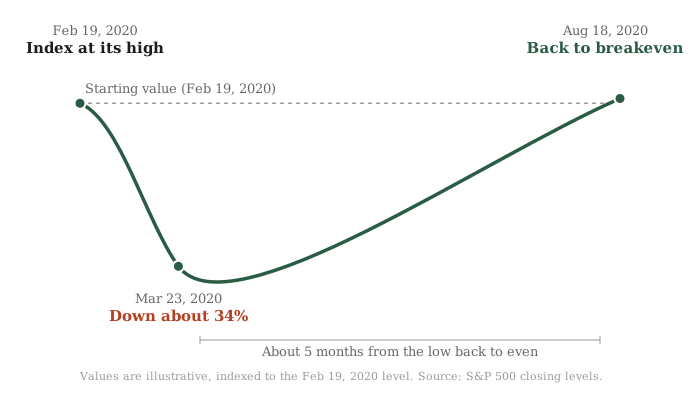
History is not a guarantee, and nothing about investing is certain. But every major market drop on record has eventually recovered. The S&P 500 fell roughly 34% in early 2020 during the COVID crash. Within about five months of that low, it had climbed back past where it started. Investors who stayed in lost nothing from that drop. The ones who sold to stop the bleeding locked in a real loss before the recovery arrived.
The time horizon matters enormously here. A 20% drop in year 3 of a 40-year retirement account is noise. That same drop at age 62, two years from when you need the money, is a different conversation. Most people opening a Roth IRA are playing a long game, which means the market’s short-term moves have much less power than they seem.
That is easy to say. It is harder to believe when the number is red. That gap between knowing something and feeling it is where most Roth IRA money is actually lost.
The Three Real Ways to Lose Money in a Roth IRA
There are three concrete scenarios where you can lose money in a Roth IRA, and most of them have nothing to do with a bad market week.
Selling during a dip. When the market falls and you move your investments to cash inside the account, the paper loss stops being temporary. You have sold shares at a low price. You would need to buy back in at a higher price later to participate in the recovery, and that timing is nearly impossible to get right. Waiting for the “right moment” to re-enter often means missing the sharpest recovery days, which tend to come right after the worst ones.
Withdrawing earnings early. Roth IRA contributions, the money you actually put in, can be withdrawn at any time without taxes or penalties. That is one of the account’s real advantages. But the earnings, the growth on top of those contributions, come with conditions. Take them out before age 59 1/2 without a qualifying reason and you will owe income tax plus a 10% penalty on those earnings. That is a real, permanent loss, not a paper one. It is also avoidable if you understand it before you need the money.
Holding high-risk or concentrated assets. A Roth IRA that holds a diversified index fund behaves very differently from one that holds a single stock, options contracts, or speculative positions. Those assets can go to zero. The answer to “can I lose everything in a Roth IRA?” is technically yes, if what you choose to hold inside it fails entirely. This is a risk of investment selection, not the account structure itself.
The most common scenario, by a wide margin, is the first one.
What to Do When Your Roth IRA Balance Drops
Step 1: Look at what you actually own, not just the balance.
If you hold a target-date fund or a mix of index funds, what you own is a share of hundreds or thousands of companies at once. Those funds do not fail when markets fall. Their price falls. Understanding what you actually own separates “the market is down” from “my investments are broken.” They are not the same thing.
Step 2: Keep contributing if you can afford to.
When the market is down, your regular contributions buy more shares than they would at a higher price. If you contribute $583 a month and the fund drops 20%, your next contribution buys 25% more shares than it would have at the peak. This is called dollar-cost averaging. It does not guarantee returns, but it means you are not just watching the dip. You are buying into it.
Step 3: Resist the urge to do something.
The desire to act when the account is down is real. It is also usually the wrong move. The market’s biggest recovery days often come within weeks of its worst ones. Moving to cash means you need to be right twice: when you exit and when you re-enter. Almost nobody gets it right consistently, even professionals with real resources behind them.
Step 4: Check your time horizon, not the current balance.
Ask yourself: when do I actually need this money? If the answer is 20 or 30 years from now, today’s balance is almost beside the point. What the account will be worth in 2045 or 2055 is what matters, and today’s lower price is simply what you are paying for those future shares.
Tip: If checking the balance frequently makes you want to do something, you are allowed to check it less often. Many experienced investors deliberately look only when they contribute. That is not avoidance. It is a practical way to stay out of your own way.
Step 5: If you are going to review anything, look at the holdings.
Make sure you are in diversified index funds, not heavily concentrated in a few individual stocks or in an asset class that does not match your time horizon. The holdings are worth reviewing once or twice a year. The balance on any given Tuesday is not.
The Part That Is Actually the Hardest
Earlier this year, I built an AI-assisted signal system I thought might flag a market drop in advance. I moved my investments to cash in a taxable account. The market rose about 10% while I waited. I eventually switched back after losing my nerve, having missed that gain entirely and then paid a higher price to buy back in.
The account I ran that experiment on was not a Roth IRA, but the lesson would have been identical anywhere. What I learned was that trying to protect against a temporary paper loss is often exactly how you create a real one. Getting the timing right requires being correct twice, and the cost of being wrong the second time is usually higher than the paper loss you were trying to avoid.
I missed the years when I could have contributed directly to a Roth IRA. By the time I understood what I had been passing on, my income had already exceeded the direct contribution limit. The account I ended up opening was a custodial Roth IRA for my child. Watching that account during a rough market stretch does not bother me the way it might have earlier in my life, because the account has 40 or more years of runway ahead of it. What the balance is today is genuinely not the point.
A Note on How This Feels
It can be genuinely uncomfortable to watch an account you funded with real, hard-earned money show a multi-thousand-dollar loss in a single week. That is not an overreaction. That is money you worked for.
What helps is separating two different questions: is the balance down, and is the strategy working? The first question will fluctuate constantly. The second one only becomes visible over years. Treating them as the same question is what leads most people to sell at exactly the wrong time.
Almost nobody who has been investing in diversified index funds for 20 or 30 years regrets staying in through the drops. Almost everyone who sold during a downturn has a version of the same story: the moment they wish they had held on.
You are not making a mistake just because the account is down right now. You are one bad week into a very long process, and those are different things.
Your One Next Step
Log in to your Roth IRA and look at what you actually own, not the balance. Find out: is it in a target-date fund or a broad index fund? Or is it sitting in cash without being invested? You do not need to change anything today. Just know what is in there. That is the whole step.
Quick Recap
- A Roth IRA can lose money, but most drops are temporary paper losses, not permanent ones.
- What turns a paper loss into a real one is almost always selling at the wrong time, withdrawing earnings early, or holding assets that can fail.
- Your time horizon matters more than any individual bad week in the market.
Common Questions
Can I lose all the money in a Roth IRA?
Technically yes, if the specific investments inside the account go to zero. That can happen with individual stocks or highly speculative positions. It is extremely unlikely with a diversified index fund or target-date fund, which spread risk across hundreds of companies. The account structure does not protect against poor investment choices inside it.
What happens to a Roth IRA if the stock market crashes?
The balance will fall during a market crash, sometimes significantly. That is expected and normal. Investors who held diversified funds through the 2008 financial crisis, the 2020 COVID drop, and other major downturns generally recovered fully and grew past where they were before. Investors who sold during those crashes often did not, because they missed the recovery. The drop itself is rarely the problem.
Can I take money out of a Roth IRA if I need it?
Yes, with conditions. Contributions (the money you originally put in) can be withdrawn at any time, tax-free and without penalty. Earnings (the growth on top of contributions) are a different story: withdrawing them before age 59 1/2 typically triggers ordinary income tax plus a 10% penalty, unless you qualify for an exception. If there is a real chance you will need this money within the next five years, a Roth IRA may not be the right place for it.
Is a Roth IRA safer than a regular brokerage account?
The tax treatment is different, but the investment risk is the same. A Roth IRA holding a diversified index fund carries the same market risk as a regular brokerage account holding the same fund. The difference is that growth inside the Roth IRA is tax-free when you withdraw it in retirement. The account structure changes the tax picture; it does not change how the investments inside it behave.
Resources
These resources can help you understand how Roth IRAs work and how to think about investment decisions inside one. None of these are endorsements, and this site has no financial relationship with any of them. They are starting points.
- IRS Roth IRA overview (official rules on contributions, withdrawals, and income eligibility)
- Investor.gov compound interest calculator (see how time in the market affects long-term growth at different return rates)
If you are thinking about opening a Roth IRA for a child, I wrote about how the custodial version works and what it actually takes to set one up: Can I Open a Roth IRA for My Child?
If your income is too high to contribute directly, the account still works the same way once you get money into it: How to Do a Backdoor Roth IRA covers the legal workaround.
For a broader look at how I think about investing, including what I got wrong before I figured it out: Investing for Beginners: How I Think About It
John Cho is the founder of BeginnerFinanceHub.com, a resource for people who are new to personal finance and want a calm, clear place to start. Learn more about John →