
This article is general education, not personalized financial advice. Every financial situation is different. Tax rules change; verify current IRS limits at IRS.gov before acting.
There is a specific kind of frustration that comes from earning “too much” for a Roth IRA. You learn about the account, you want to open one, and then you find out you are above the income limit.
That was me. By the time I understood what a Roth IRA was, my income had grown past the contribution limits. The years when I was eligible, I did not even know the account existed.
The backdoor Roth IRA is the legal workaround. It is a two-step process: you put after-tax money into a traditional IRA, then convert that account to Roth. The IRS allows it. When done correctly, the result is the same as a direct Roth contribution. That money grows tax-free and comes out tax-free in retirement.
The one move: A backdoor Roth IRA lets you contribute to a Roth even when your income is above the normal limit, by converting a traditional IRA contribution rather than contributing directly.
Why This Matters
Roth IRAs are one of the few accounts where your money grows completely tax-free. You put in after-tax dollars, the account compounds over time, and when you withdraw in retirement, you pay nothing on the gains. No required minimum distributions during your lifetime, either.
The catch is the income limit. For 2026, single filers begin to lose eligibility at $153,000 in modified adjusted gross income, and the ability to contribute phases out entirely at $168,000. For married couples filing jointly, the phase-out runs from $242,000 to $252,000. These numbers adjust for inflation each year. Check the current figures at IRS.gov before contributing.
If your income is above those thresholds, you cannot put money directly into a Roth IRA. But there is no income limit on contributing to a traditional IRA, and there is no income limit on converting a traditional IRA to Roth. The backdoor Roth takes advantage of that gap.
If you have access to this strategy and can afford the contribution, it is one of the most effective retirement tools available to high earners. The backdoor path is not a loophole; it is a strategy the tax code allows.
What a Backdoor Roth IRA Actually Is
A backdoor Roth IRA is not a separate account type. It is a process.
You make a contribution to a traditional IRA using after-tax money (this is called a non-deductible contribution), then convert that traditional IRA to a Roth IRA. After the conversion, the money lives in a Roth account and follows Roth rules going forward.
The reason this works without a large tax bill: because you contributed after-tax dollars, the IRS already taxed that money. When you convert to Roth, you owe taxes only on any gains that accumulated between the contribution and the conversion. If you convert quickly, typically the same day or within a few days, there is usually little or no gain, which means little or no additional tax.
One constraint: the annual contribution limit still applies. For 2026, you can contribute up to $7,500 per year, or $8,600 if you are 50 or older. The IRS publishes updated figures at IRS.gov each year.
The backdoor route takes two steps and requires a specific tax form each year. The end result is the same Roth account with the same tax-free growth.
How to Do It: Step by Step
Step 1: Confirm you actually need the backdoor route.
Look up your modified adjusted gross income for the year. If it is above the phase-out range, roughly $168,000 for single filers and $252,000 for married filing jointly in 2026, you cannot make a direct Roth contribution. Verify the current limits at IRS.gov, since they adjust annually. If you are under the limit, you can contribute directly and skip this process entirely.
Step 2: Check whether you have existing traditional IRA funds.
This step matters more than most guides acknowledge. If you have pre-tax money sitting in a traditional IRA from a prior rollover, deductible contributions, or an old 401(k) rolled into an IRA, the pro-rata rule applies. You may owe more tax than expected on the conversion. The pro-rata rule is explained in the next section. If you have no existing traditional IRA funds, continue to step 3.
Step 3: Make a non-deductible contribution to a traditional IRA.
Open a traditional IRA at a brokerage if you do not already have one. Contribute up to the annual limit in after-tax dollars. Do not invest the funds yet. Leave them as cash so that by the time you convert, there are no gains to tax.
Step 4: Convert the traditional IRA to Roth.
Contact your brokerage and request a Roth conversion. Most firms handle this online. You are moving the funds from the traditional IRA to a Roth IRA at the same institution. If you do this within a few days of the original contribution, the taxable amount is typically zero or close to it.
Step 5: File IRS Form 8606 with your taxes.
This is the step people miss. Form 8606 documents that your traditional IRA contribution was non-deductible, meaning you already paid tax on it. Without this form, the IRS has no record that you used after-tax money, and you could be taxed again on the conversion. File it every year you do a backdoor Roth. The IRS instructions are at IRS.gov.
Note: After completing these steps, you may receive a 1099-R form showing a taxable amount of zero or a small number. That is normal. Your completed Form 8606 is the explanation.
Going Deeper: The Pro-Rata Rule
If you have existing pre-tax money in traditional IRAs, the pro-rata rule changes the tax math significantly. The IRS does not let you treat only the new after-tax dollars as the converted amount. Instead, it looks at the ratio of pre-tax to after-tax money across all your traditional IRA accounts combined.
Say you have $90,000 in a traditional IRA from an old rollover (pre-tax) and add $7,000 in a new non-deductible contribution. Your total is $97,000; about 7% is after-tax. When you convert that $7,000 to Roth, roughly 93% is treated as pre-tax money, so you owe income tax on approximately $6,510.
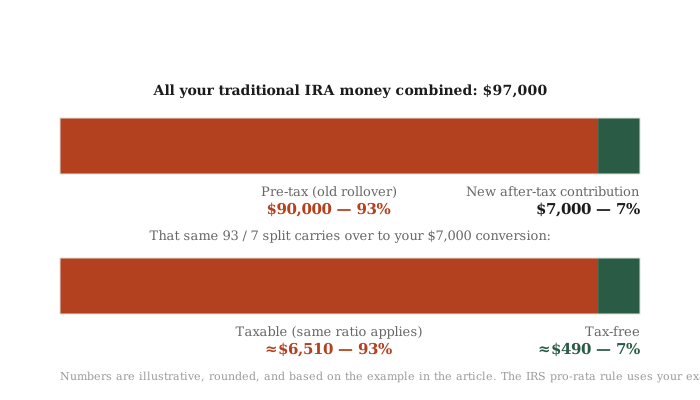
This is why the backdoor Roth works most cleanly for people with no other traditional IRA balances. If you have a large pre-tax IRA, the math changes. Some people in this situation roll their pre-tax IRA funds into a current employer 401(k) plan first, if the plan allows it, which removes those funds from the pro-rata calculation. A CPA can help you model this before you proceed.
Start with steps 1 through 5 above. Come back to the pro-rata calculation only if step 2 reveals you have pre-tax IRA funds.
A Note on How This Feels
There is a particular frustration to learning about a financial tool too late.
I did not know Roth IRAs existed during the years I was earning $7 or $8 an hour at my first job, carrying debt, and working three jobs to keep up. By the time I learned about them, my income had grown past the direct contribution limit. Those low-bracket years are gone.
The backdoor Roth is a real tool, even if it requires more steps than a direct contribution. It means the door to Roth’s tax-free growth is not fully closed at higher income levels.
You are not behind. The right move is the one available to you now.
Your One Next Step
Look up your modified adjusted gross income from your most recent tax return. Then check the current Roth IRA income limits at IRS.gov. If you are above the threshold, decide whether the $7,000 contribution fits your current financial situation. That is the whole question for now. You do not need to open anything yet.
Quick Recap
- A backdoor Roth IRA lets high earners access Roth accounts by making a non-deductible traditional IRA contribution and then converting it to Roth.
- The process works cleanly when you have no other pre-tax traditional IRA funds; if you do, the pro-rata rule changes the tax math.
- File IRS Form 8606 every year you do this so the IRS has a record that you already paid tax on the contribution.
Common Questions
Is the backdoor Roth IRA legal?
Yes. The IRS explicitly allows Roth conversions from traditional IRAs, with no income limit on conversions. The backdoor Roth has been a standard strategy for many years, and financial institutions handle these transactions routinely. Congress has discussed eliminating it at various points, but as of 2026 it remains available.
What if I already have money in a traditional IRA?
The pro-rata rule applies. The IRS calculates your tax based on the ratio of pre-tax to after-tax money across all your traditional IRA accounts, not just the new contribution. If you have a large pre-tax balance, converting only a small after-tax contribution will still trigger tax on most of that conversion. Work through the math with a CPA before proceeding.
Can I do a backdoor Roth every year?
Yes, as long as you have earned income and your income remains above the direct contribution threshold. Each year follows the same two steps: a non-deductible traditional IRA contribution, then a conversion. Each year also requires a new Form 8606.
Does converted money grow the same way as a regular Roth?
Yes. Once the funds are in the Roth IRA after conversion, they follow all standard Roth rules: tax-free growth, tax-free qualified withdrawals in retirement, and no required minimum distributions during your lifetime.
Resources
These resources can help you understand the mechanics and verify current rules. None of these are endorsements, and this site has no financial relationship with any of them.
- IRS: Roth IRA Contribution Limits (official income limits and eligibility rules, updated annually)
- IRS: About Form 8606 (the form you file each year to document non-deductible IRA contributions)
- Can I Open a Roth IRA for My Child? (if you are thinking about starting this for the next generation)
- Should I Max Out My 401(k)? (how to think about 401(k) contributions alongside a backdoor Roth)
- Can You Lose Money in a Roth IRA? (once the money is converted, what actually happens if the market drops)
- Investing for Beginners: How I Actually Think About It (BFH, the broader framework a backdoor Roth fits inside)
John Cho is the founder of BeginnerFinanceHub.com, a resource for people who are new to personal finance and want a calm, clear place to start. Learn more about John →